How does the Beam Spacer ensure a perfect fit with the tire bead during tire vulcanization?
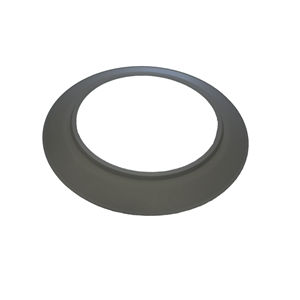
In the tire manufacturing process, Chafer Disc (also known as bead spacer or triangular rubber shaping disc) does not directly participate in the vulcanization reaction, but is a key "positional reference" that connects the molding and vulcanization processes. Its core mission is not to "dead top" the tire bead inside the vulcanizing machine, but to ensure that the tire bead is in the optimal state before entering the mold through physical constraints and geometric profiling, so as to achieve perfect fit with the mold tire bead area when the vulcanizing capsule expands.
Firstly, geometric profiling is the foundation for achieving fitting. The outer edge of the Bead Spacer is not simply circular, but is reverse modeled based on the bead seat radius and triangular rubber profile in the tire cross-section design drawing. On the forming drum, the R-angle inclined surface of the partition is tightly attached to the outer side of the steel wire ring and the triangular rubber, and the high rigidity of polypropylene material (Shore hardness 65-75D) is used to forcibly "break" the uncured soft tire ring into the required curvature for design. This physical shaping effect eliminates small wrinkles or curvature deviations of the tire bead in a free state, laying a precise geometric foundation for subsequent vulcanization bonding.
Secondly, micrometer level dimensional stability ensures consistency in bonding. Compared to paper pads that are prone to moisture absorption and deformation, pp tire bead pads have extremely low water absorption rates (<0.01%) and high Vicat softening points (135-145 ℃). This means that in the thermal radiation environment around the vulcanizing machine, it can maintain a thickness tolerance within ± 0.05mm for a long time and has extremely high flatness. This stability ensures that the preset position height of each tire bead is consistent, avoiding axial movement of the bead caused by thermal expansion and contraction of the partition or moisture.
Furthermore, the low adhesion surface of the mirror promotes dynamic bonding. The surface of high-quality PP tire bead separators has undergone mirror polishing treatment (Ra<0.8 μ m), resulting in extremely low surface energy. During the process of forming the drum and transferring the tire blank, this characteristic allows the bead material to undergo slight elastic sliding on the surface of the partition without adhesion or pulling. When the tire blank is loaded into the vulcanization mold, the tire bead can smoothly slide into the toe/heel area of the mold without being skewed due to "sticking" or "sticking".
Finally, the coaxial positioning system locks in the fitting accuracy. The inner hole of the partition and the main shaft of the forming drum are matched with a gap and supplemented with positioning keys or step surfaces, ensuring that the left and right partitions are strictly coaxial. In the initial stage of vulcanization, even if the capsule is not fully inflated, the partition still maintains the radial runout accuracy of the tire bead. When the high-temperature and high-pressure capsule begins to expand, the tire bead can be uniformly stressed and spread towards the mold cavity under the stable support provided by the partition, ultimately achieving a perfect fit without dead corners or stress.
In summary, PP tire bead separators provide absolute positional support for the tire beads in the pre vulcanization stage through a four fold mechanism of "contour shaping, rigid support, low viscosity slip, and coaxial limit". They are a key invisible contributor to achieving high uniformity and low dynamic imbalance in high-end tires.
Changshu Yongchengsheng Hardware Products Co., Ltd. specializes in the production and sales of tire bead separators and PP tire bead pads. If you need them, please contact us at+86-13506249539; Contact email: ljd706627@gmail.com