Lubricant for production line rhythm: dynamic adaptation of PP tire bead pad in intelligent logistics
In the discrete automation production line of tire manufacturing, time is the most expensive cost. From the extrusion of the triangular rubber to the formation of the tire bead, any stagnation in each stage will trigger a chain of shutdowns and waiting. In this high-speed circulation system, the PP bead spacer plays a more complex role than "isolation" - it is a universal interface connecting the robotic arm, visual system, and vulcanizing machine. This article will re-examine this industrial consumable from the perspective of logistics automation and cycle optimization.
1、 Standardized interfaces and the "fingertip" logic of robotic arms
Modern tire factories commonly use SCARA robots or six axis robotic arms for material transfer. For soft and easily deformed tire beads, directly grasping them can easily cause cross-sectional distortion. The PP partition acts as a 'hard contact interface' here.
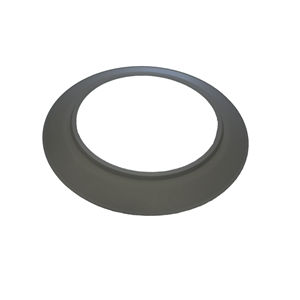
The central through-hole of the partition is not only designed for weight reduction, but also serves as the positioning reference for the end effector of the robotic arm. Through the cooperation of vacuum suction cups and central holes, the robotic arm can complete the action cycle of "recognition suction placement" within 0.5 seconds. The chamfer design and high smoothness surface of the partition edge ensure that there will be no electrostatic adsorption or friction jamming during multi-layer stacking, thereby ensuring a picking success rate of over 99.9%. This standardized physical interface eliminates the risk of downtime caused by irregular materials.
2、 Stacking dynamics and center of gravity stability
The stability of the center of gravity of the tire bead stack is crucial during AGV (Automated Guided Vehicle) transportation. If there is a lack of effective interlayer isolation, multiple layers of raw glue may experience slight relative displacement during acceleration or emergency stop, and the cumulative effect may lead to the collapse of the entire pallet of materials.
The annular reinforcing rib structure of the PP partition plays a "self-locking" role. When a layer of partition is placed on the tire bead, its bottom contour surface closely adheres to the curved surface of the next layer of tire bead, forming a constraint similar to a mortise and tenon structure. This design significantly reduces the center of mass height of the stack and transmits horizontal inertial forces to the bottom of the tray through the partition. The data shows that after using standard PP partitions, the tire bead displacement rate during logistics can be reduced to less than 0.1%, greatly reducing the scrap rate caused by collisions.
3、 Cleanliness control and foreign object management
The cleanliness of tires before vulcanization directly affects the quality of the finished product, as tiny fibers or plastic debris can cause sidewall bulges. Traditional paper gaskets generate paper scraps after repeated use, while PP partitions provide a closed-loop cleaning solution.
Due to its dense and hydrophobic surface, PP separators are not easily able to adsorb carbon black dust in the workshop air. Even if contaminated with oil, it can be quickly cleaned and reused through an online cleaning machine. More importantly, the toughness of PP material means that it will only undergo elastic deformation rather than brittle fracture when subjected to accidental impact. This means that it will not produce imperceptible small fragments mixed into the adhesive material like metal or ceramic fixtures, thus avoiding the risk of foreign object defects from the source.
4、 The Potential of Digital Traceability as a Carrier
With the popularity of MES (Manufacturing Execution System), material traceability has become unprecedentedly important. The future PP tire bead separators are evolving from simple physical tools to data carriers.
By embedding high-temperature resistant RFID chips or laser engraving Data Matrix codes inside the partition, each partition can be assigned a unique "ID card". The system can monitor in real-time the frequency of use, cleaning cycle, and specific location of the partition on the production line. When the partition reaches the preset service life threshold, the system will automatically issue a replacement warning to achieve preventive maintenance and avoid batch quality accidents caused by tooling failure.
Changshu Yongchengsheng Hardware Products Co., Ltd. specializes in the production and sales of tire bead separators and PP tire bead pads. If you need them, please contact us at+86-13506249539; Contact email: ljd706627@gmail.com