Bead Spacer: Precision Engineering Hidden at the Edge of Tires
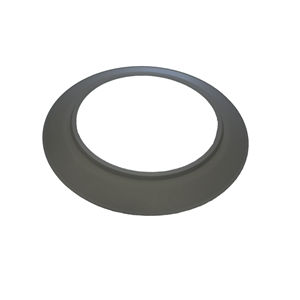
When a fully loaded truck weighing 40 tons makes a sharp turn, the shear force between the tire and the wheel rim exceeds 8000 Newtons. What steadily transmits this force is the tire bead partition that most people have never seen before. This annular component, with a thickness of only 3 to 8 millimeters, undertakes the most demanding mission during tire assembly - to withstand tensile stress exceeding 300 kilopascals during inflation without permanent deformation, while ensuring that it does not adhere or tear with the tire bead during disassembly.
From fiberboard to polymer: the iterative logic of materials
The early Circular plastic flaps can be traced back to the 1950s, when tire factories commonly used a solution of impregnated canvas overlaid with vulcanized rubber. The problem with this structure is that it exhibits significant anisotropy - the longitudinal strength is sufficient, but the latitudinal strength is prone to wrinkling under wheel rim compression. In the 1980s, thermosetting phenolic resin fiberboard became mainstream, with a heat resistance of up to 180 ℃. However, its fatal flaw was its high brittleness, and repeated disassembly and assembly more than three times would result in edge cracking.
The emergence of the bead separator changed this situation. After being reinforced with glass fiber, the flexural modulus of polypropylene homopolymer can be increased from 1500MPa to over 3500MPa, while maintaining the resilience characteristics of thermoplastic materials. This means that during the installation of the tire onto the wheel rim, the partition can recover to its original state after undergoing significant bending deformation, rather than leaving irreversible damage like thermosetting materials. Actual test data shows that high-quality PP bead separators can withstand more than 50 cycles without cracking during simulated disassembly and assembly tests, which is more than 5 times that of traditional phenolic resin boards.
Fluid dynamics considerations in geometric design
The working environment of tire bead partition is much more complex than imagined. When the tire is inflated, the airflow velocity in the bead area can reach more than ten meters per second between the partition and the wheel rim, forming a local vortex. If the surface of the partition is too flat, the airflow will form a low-pressure area on the back of the partition, causing an "adsorption effect" and making tire disassembly difficult.
For this reason, micro groove diversion structures have been introduced in the engineering design. On the mating surface between the partition and the wheel rim, a spiral micro groove with a width of 0.3mm and a depth of 0.5mm is set every 15 °. The purpose of these grooves is to guide high-pressure gas to the back of the partition and disrupt vacuum adsorption. Experiments have shown that PP bead separators with guide grooves can reduce tire disassembly force by about 40% and significantly reduce maintenance time. At the same time, the chamfer angle of the outer edge of the partition is precisely calculated - usually 12 ° to 15 °. If it is too small, it will cause installation difficulties, while if it is too large, it will weaken the contact pressure of the sealing surface.
Millimeter level game of dimensional tolerances
The fitting tolerance of the tire bead partition directly determines whether the tire will have a "slip ring" hazard. The so-called slip ring refers to the slight displacement of the tire bead relative to the wheel rim during high-speed driving, which accumulates to a certain extent and causes the root of the valve to break. According to industry standards, the clearance between the inner diameter of the partition and the convex peak of the wheel rim should be controlled between 0.2mm and 0.5mm. Excessive clearance and inaccurate positioning of the tire bead; The gap is too small, causing the partition to deform under pressure during installation, resulting in a loss of preload force.
The linear expansion coefficient of PP material is about 7 × 10 ^ -5/℃, which is 7 times that of steel. This means that on high-temperature roads in summer, the inner diameter of the partition will increase by 0.3mm to 0.8mm due to thermal expansion. Excellent PP bead partition formulations will use talcum powder or calcium carbonate fillers to compress the expansion coefficient to below 4 × 10 ^ -5/℃, ensuring effective interference fit even at extreme temperatures.
Changshu Yongchengsheng Hardware Products Co., Ltd. specializes in the production and sales of tire bead separators and PP tire bead pads. If you need them, please contact us at+86-13506249539; Contact email: ljd706627@gmail.com