Beam Spacer: The 'Invisible Skeleton' for Precise Tire Manufacturing
In the preparation workshop of tire manufacturing, the fitting and temporary storage of the steel wire ring and the triangular rubber are the key steps that determine the final dynamic balance of the tire. In this process, the bead spacer, commonly known as the triangular rubber shaping plate in the industry, plays a crucial role. With the popularization of radial tire technology, traditional paper separators are rapidly being replaced by PP bead separators due to their susceptibility to moisture absorption, chip shedding, and low strength. This industrial consumable, which uses polypropylene injection molding, has become the first line of defense to ensure tire bead accuracy due to its excellent physical stability and recyclability.
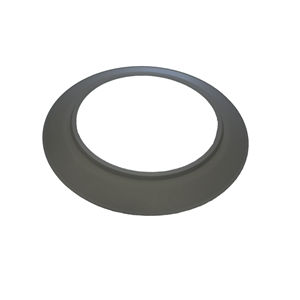
The core value of the Bead Spacer lies in its precise structural design and perfect combination of material properties. Unlike flat gaskets, it is designed according to the tire profile, with a specific curvature radius (R value) on the surface. Taking the adaptation of 12.00R20 all steel load tires as an example, the outer diameter of the partition is usually between 440mm and 480mm, and the curvature of the disc surface must be fully fitted with the steel wire ring. In order to prevent displacement during multi-layer stacking, the inner cavity of the partition is designed with one to two circular positioning ribs, and a large hole is opened in the center for heat dissipation and vacuum suction of the robotic arm. This structure ensures that the steel wire ring will not deform due to gravity or external forces during static storage or transportation, thereby ensuring the geometric roundness of the tire ring.
From the product data, the performance of high-quality tire bead partitions far exceeds that of traditional materials. The mainstream products use co polymerized polypropylene modified material injection molding, with a density maintained between 0.90 grams and 0.91 grams per cubic centimeter, which makes the single piece extremely lightweight. For example, a partition with a diameter of 450 millimeters and a thickness of 1.5 millimeters weighs only about 0.5 kilograms, greatly reducing the labor intensity of workers. In terms of mechanical strength, its tensile strength is usually stable between 28 megapascals and 35 megapascals, and its bending modulus exceeds 1300 megapascals, which is sufficient to withstand the stacking pressure of multi-layer heavy-duty all steel tire beads without plastic deformation. Of particular note is its thermal performance. The modified PP material can reach a thermal deformation temperature of 110 ° C to 125 ° C, which can adapt to the short-term high temperature environment near the vulcanizing machine. At this temperature, the dimensional shrinkage rate is extremely low, ensuring long-term dimensional stability.
In practical applications, the Bead cap solves many pain points in the rubber industry. Due to the non-polar crystalline polymer nature of polypropylene, its surface energy is extremely low. When combined with mirror polishing or micro etching treatment processes, its surface roughness can be controlled within Ra0.8 microns. This characteristic makes it difficult for uncured sticky rubber to adhere, reducing the scrap rate caused by bead adhesion from over 5% in the cardboard era to less than 1%. In addition, PP material does not absorb water, rust, and is resistant to acid, alkali, and rubber oil corrosion. After a single use, it can be used 500 to 800 times, greatly diluting the cost of single use.
When selecting, engineers need to focus on thickness tolerances and surface treatment. In highly automated production lines, the thickness tolerance of the partition must be strictly controlled within plus or minus 0.05 millimeters, otherwise it may cause the stacking height to exceed the standard or the mechanical arm to fail to grasp. For high-end tires using ultra-high viscosity formulations such as solution polymerized styrene butadiene rubber (SSBR), it is recommended to use PP bead separators coated with PTFE on the surface to achieve better anti adhesion effects.
In summary, this seemingly inconspicuous circular plastic disc is actually a bridge connecting rubber components and automation equipment. It silently guards the "ankle" of every tire with precise mold size and stable polypropylene properties, and is an indispensable basic component for modern tire industry to move towards high quality and efficiency.