Bead Spacer - Precision Isolation Fixture in Tire Forming Process
In the production process of radial tires, after the steel wire ring and apex rubber are formed by a laminating machine, they need to be stacked in multiple layers for temporary storage and waiting for the forming drum to grasp. If ordinary cardboard or no isolation measures are used in this process, the soft uncured rubber material is prone to interlayer adhesion, moisture absorption deformation, or edge collapse, ultimately affecting the geometric accuracy of the tire bead. A bead spacer/bead separator, commonly known as a triangular rubber shaping plate, is a circular injection molding tool specifically used for isolating, supporting, and shaping bead components. The PP tire bead pad, which is injection molded from copolymerized polypropylene (PP) raw material, has fully replaced traditional paper separators and become a standard configuration for all steel, semi steel, and engineering tire production lines due to its size stability, oil and temperature resistance, low-energy surface adhesion resistance, and recyclability.
Product Structure Features and Common Specifications
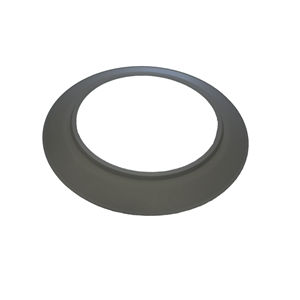
A typical tire bead partition is a disc-shaped injection molded part with a curved surface (R value) that matches the contour of the tire bead. The inner cavity is equipped with 1-3 circular positioning ribs to limit the displacement of the steel wire ring. A large hole is opened in the center for ventilation and robotic operation, and reinforced protrusions are set around the through-hole to prevent crushing. The surface is often polished with mirror finish or treated with micro etching to reduce surface energy.
The commonly used industrial specifications cover car tires ranging from 13 "to 22" and some large-sized tire beads for commercial vehicles, with typical thicknesses of 1.2mm, 1.5mm, 2.0mm, and 3.0mm. Among them, the 1.5mm double-sided precision polishing version is the most popular due to its balance between rigidity and stacking height control. The outer diameter is matched according to the number of inches of the tire bead, for example, the outer diameter of the partition that is compatible with 12.00R20 all steel tires is mostly between Φ 440 and Φ 480mm.
The Triangle rubber tire partition with smooth surface treatment can reduce the adhesion failure rate of Triangle rubber stacking from 5% to 8% of paper partitions to below 1%, and the qualified rate of automatic feeding station grasping can reach over 99.7%. Because PP does not absorb water and does not experience expansion or warping during high humidity rainy seasons, it avoids the ovality deviation of the tire bead caused by cardboard deformation.
Selection and Application Points
During the static stacking stage of the steel wire ring and triangular rubber, the tire bead partition plays a triple role: ① physical isolation to prevent the adhesive material from sticking to each other; ② Imitation curved surface supports the curvature of the tire bead; ③ Low surface area can make demolding/removal smooth and residue free. Compared to disposable cardboard, PP material is resistant to rubber additives such as sulfur, accelerators, and operating oils, and can be repeatedly circulated after normal cleaning, resulting in significantly lower overall usage costs.
When selecting, three core parameters should be verified: the appropriate size of the tire bead inch (determining the outer diameter and curve R value), thickness (affecting the total height and rigidity of the stack, with a recommended tolerance of ± 0.05mm for automatic lines), and surface treatment method (mirror finish is suitable for most formulations, and PTFE coating is suitable for high viscosity SSBR formulations). If the temporary storage area of the partition is close to the high-temperature area next to the vulcanizing machine, a heat-resistant modified grade should be designated to prevent thermal aging and brittleness.
The seemingly inconspicuous PP bead divider, with precise thickness control to the silk level and excellent weather resistance and anti sticking performance of polypropylene material, silently guards the dimensional accuracy and surface integrity of the bottommost part of each tire - the bead area, and is an indispensable "invisible cornerstone" in the lean tire manufacturing system